Table of Contents
- What Professional Commercial Office Cleanout Services Include
- Office Cleanout Checklist: Planning Your Project
- How Long Does an Office Cleanout Take
- Office Cleanout Cost: Pricing Factors and What to Expect
- Reuse, Donation, and Recycling: What Happens to Office Items
- Compliance, Insurance, and Professional Standards
- Choosing a Reliable Commercial Cleanout Provider
- Frequently Asked Questions
Last Updated: October 17, 2026
What Professional Commercial Office Cleanout Services Include
Professional commercial office cleanout services handle the complete removal and disposal of furniture, equipment, and debris from office spaces, saving businesses time, protecting floors and infrastructure, and ensuring proper handling of sensitive materials.
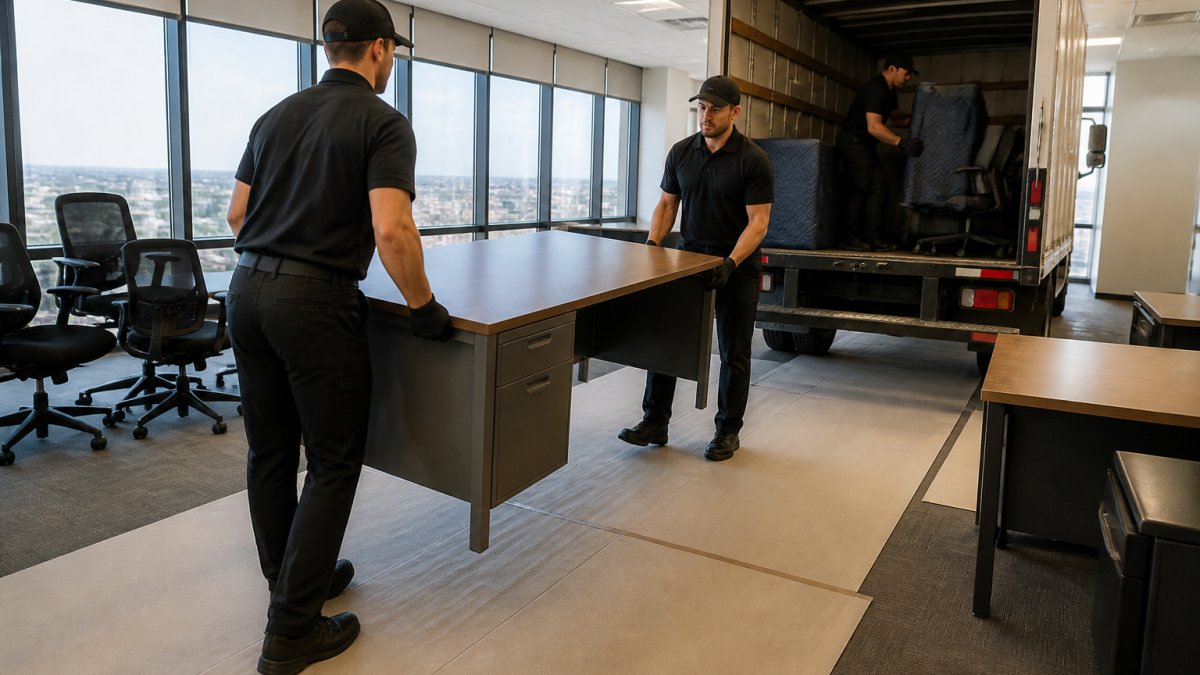
A professional commercial office cleanout goes far beyond hauling trash: it involves systematic dismantling, careful loading, floor protection, and responsible disposal or recycling.
Office Furniture Removal and Dismantling
Office furniture removal is one of the largest components of any commercial office cleanout.
Dismantling cubicles and modular workstations demands technical knowledge.
Load & Leave prioritizes floor protection throughout furniture removal, using protective coverings and equipment pads to keep your property pristine, a detail that distinguishes professional services from basic junk hauling.
Electronics and Equipment Handling
Electronics disposal requires specialized attention. Computers, monitors, printers, servers, and networking equipment contain valuable materials and potentially hazardous components.
Data security is critical. Hard drives and storage devices must be handled according to data protection standards.
Electronics recycling follows federal and state regulations.
Debris and Trash Removal
Beyond furniture and equipment, commercial office cleanouts generate significant debris: packaging, office supplies, broken fixtures, and general trash. Professional services separate recyclables from general waste, reducing landfill impact and often offsetting costs.
Office Cleanout Checklist: Planning Your Project
A successful commercial office cleanout requires advance planning. This checklist covers the key steps before your service appointment.
Assessment and Inventory
Start by cataloging what needs to be removed.
Measure doorways, hallways, and elevator dimensions, and identify obstacles like low ceilings, tight corners, or narrow passages so your provider can plan the most efficient removal route.
Determine access requirements: building access cards, permitted loading hours, and advance notice to management. Clarifying these prevents delays on service day.
Data Security and Sensitive Materials
Review what data or confidential materials remain. Hard drives, file cabinets with business records, and archived documents need secure handling, so communicate any data destruction requirements to your commercial cleanout provider before the appointment.
Some offices contain regulated materials like old pharmaceutical samples, chemical supplies, or other controlled items requiring specialized disposal. Identify these early and discuss handling with your provider.
Building Access and Logistics
Coordinate with your building management or landlord.
Plan your parking and loading area.
Confirm the date and time window. Reliable commercial office cleanout services offer same-day and after-hours availability, but confirming your needs ensures the crew arrives prepared.
How Long Does an Office Cleanout Take
The duration of a commercial office cleanout depends on volume, dismantling complexity, and accessibility.
Furniture requiring dismantling takes longer than items ready for immediate removal. Stairs, narrow passages, elevator coordination, and restricted loading windows add time, as do floor protection and careful handling.
Professional services provide time estimates during the initial assessment.
Office Cleanout Cost: Pricing Factors and What to Expect
Commercial office cleanout pricing is rarely a single flat rate. Most providers build an estimate from measurable inputs, and understanding that structure lets you compare quotes fairly.
How a Commercial Cleanout Estimate Is Built
Providers often quote a range first, then confirm a fixed price after a walkthrough or photo review. Ask which inputs drive the range and what would move you to the high end; that separates a real estimate from a guess.
The Cost Drivers That Matter Most
Volume and weight. Material amount is the largest single driver.
Access and logistics. Stairs, long carry distances, narrow doorways, and restricted loading windows all add labor.
Scheduling. Same-day and after-hours service usually carries a premium because it requires holding crew capacity or paying overtime.
Reading a Quote Line by Line
A useful commercial quote separates labor, disposal, specialty handling, and pass-through fees rather than one bundled number. Look for these line items:
- Crew size and estimated hours
- Truck or dumpster volume included
- Disposal and tipping fees, and whether they are estimated or capped
If a quote omits disposal fees or data destruction, ask where those costs appear. A low headline number excluding tipping fees is not comparable to an all-in quote.
Example Scenarios
These scenarios illustrate how the same service scales. They are illustrative patterns, not published rates; your provider's quote reflects local labor and disposal costs.
- Small suite, light furniture. One to three private offices with desks, chairs, and a few filing cabinets, ground-floor access. Typically a short crew visit measured in hours, with disposal dominated by a partial truck load.
- Mid-size floor with cubicles. Twenty to forty workstations requiring dismantling, a server closet, and a mix of paper records and electronics. Labor and dismantling dominate the estimate; certified e-waste handling is a separate line.
- Multi-floor closure with restricted access. Several floors, freight elevator scheduling, after-hours loading, and a large volume of furniture plus regulated items such as batteries or lamps. Access premiums and specialty handling push this toward the high end.
What Usually Is Not Included
Most quotes exclude dumpster permits, building fines for improper loading, hazardous waste disposal beyond standard e-waste, and repair of damage caused before the crew arrives. Confirm these exclusions up front so the final invoice matches the quote.
How to Compare Providers Fairly
Normalize every quote to the same scope before comparing: same volume, dismantling, data destruction, and scheduling window. Then compare the all-in number and the assumptions behind it. A provider that explains its inputs is easier to hold to the quoted price than one offering a single round number.
Request a written, itemized commercial cleanout estimate
Reuse, Donation, and Recycling: What Happens to Office Items
Responsible commercial office cleanout services don't simply dispose of everything.
Office furniture in good condition has significant resale value.
Electronics recycling is environmentally responsible and often legally required.
Donation provides tax benefits for many businesses. Qualified donations to nonprofits generate deductible contributions (Publication 526 (2025), Charitable Contributions).
Compliance, Insurance, and Professional Standards
Commercial cleanouts happen inside buildings with rules and a regulatory framework governing what can be hauled, how electronics and regulated materials are handled, and what paperwork protects the property owner. Here's a practical checklist for verifying a provider and clearing building requirements before service day.
Certificates of Insurance and What to Request
Before any crew enters a commercial building, request a certificate of insurance (COI) and confirm it names the right parties.
Verify three things on the COI: the policy is current, the coverage limits meet your building's minimum, and the named insured matches the company you hired.
Licensing and Business Registration
Junk removal and hauling businesses are regulated at the state and local level, and requirements vary. Ask for the provider's business license and any required hauling or waste-transport registration. Some jurisdictions require a specific permit for certain waste streams.
Building Rules: Loading Docks, Freight Elevators, and Permits
Commercial properties commonly impose conditions on large removals. Confirm the following with your property manager before booking:
- Loading dock reservation. Many buildings schedule dock use in time blocks. Book the window your crew needs, including setup and cleanup.
- Freight elevator protection and booking. Freight elevators often require protective pads and a reserved time slot. Passenger elevators are usually off-limits for furniture and debris.
- Certificate of insurance on file. The building may not release the dock or elevator until the COI is approved.
Data Security and Confidential Records
Data-bearing devices and paper records require handling beyond standard hauling. If your organization has retention or client confidentiality obligations, route the decision through legal or compliance before the cleanout date.
Regulated and Specialty Materials
Not everything in an office can go in a standard truck load. Common items requiring separate handling include:
- Batteries, including lithium-ion packs from laptops and backup power units, which have specific transport and recycling requirements
- Fluorescent lamps and ballasts, which contain mercury and are regulated as universal waste in many states
- Electronic waste, which several states regulate separately from general solid waste and should go to a certified recycler
Documentation to Keep After the Job
Collect and file the signed quote and any change orders, recycling and donation receipts, and the final invoice. These records support tax deductions for qualified donations, satisfy audit and retention requirements, and document that regulated materials were handled properly.
A Pre-Booking Compliance Checklist
- COI received and approved by property management, with required additional-insured language
- Business license and any hauling or waste-transport registration verified
- Loading dock and freight elevator reserved, with protection requirements confirmed
Working through this list before the crew arrives prevents the most common cause of delayed, over-budget commercial cleanouts: paperwork and building access discovered on the morning of the job.
Ask about insurance, licensing, and building coordination for your cleanout
Choosing a Reliable Commercial Cleanout Provider
Selecting the right provider ensures your commercial office cleanout runs smoothly. Several factors distinguish professional, reliable providers from less dependable alternatives.
Same-Day and After-Hours Availability
Business operations don't always align with standard service hours. Reliable providers offer same-day appointments and after-hours scheduling, letting office closures, renovations, and relocations proceed without disrupting ongoing business.
Load & Leave provides same-day availability and flexible scheduling, including early morning and evening appointments, essential for businesses managing tight timelines or sensitive transitions.
Transparent Pricing and No Hidden Fees
Professional providers quote honestly and comprehensively. No-obligation estimates should include all costs without surprise charges after service. Transparent pricing builds trust and allows accurate budgeting.
Many businesses hesitate to switch from larger national chains over hidden fees.
Direct Communication and Discretion
Office cleanouts sometimes involve sensitive situations. A business closing quietly, a confidential relocation, or a workspace consolidation may need discretion.
Direct communication with ownership ensures your specific needs are understood and addressed. Load & Leave, founded by Michael Gergis and Luke Haddad, provides direct access to decision-makers from your initial call through project completion.
| Planning Element | Key Consideration | Impact on Service |
|---|---|---|
| Building access | Elevator availability, doorway dimensions, parking | Affects crew size and service duration |
| Data security | Hard drive destruction, confidential records | Requires specialized handling and certification |
| Timing | Business hours, tenant restrictions, building policies | Influences availability and pricing |
| Item complexity | Modular systems, electronics, hazardous materials | Extends timeline and increases labor costs |
| Floor protection | Commercial property standards, damage liability | Non-negotiable for professional service |
| Recycling goals | Donation opportunities, e-waste certification | Reduces costs and environmental impact |
Commercial office cleanouts represent a significant undertaking requiring professional expertise, reliable equipment, and careful planning. Load & Leave delivers professional commercial office cleanout services with transparent pricing, floor protection, and flexible scheduling tailored to your business needs. Get a custom quote from Load & Leave for your commercial office cleanout and experience the difference that direct communication and professional accountability make in your office transition.
Frequently Asked Questions
What does a professional commercial office cleanout service include?
A professional commercial office cleanout service handles furniture removal (desks, chairs, cubicles, filing cabinets), electronics and equipment disposal, debris and trash hauling, and final space clearing. Most providers also offer dismantling of workstations.
How much does a commercial office cleanout cost?
Office cleanout cost depends on the volume of items, complexity of removal, building access requirements, and timing. Pricing typically reflects the quantity of furniture and equipment, whether special handling is needed for heavy or delicate items, and whether same-day or after-hours service is requested. Request a no-obligation custom quote based on your specific project details rather than relying on fixed pricing.
How long does an office cleanout take?
Timeline varies based on office size, volume of items, and complexity. A small office with basic furniture may take 2-4 hours, while a larger commercial space with extensive equipment could require 8+ hours or multiple visits. Factors affecting duration include workstation dismantling, freight elevator access, narrow corridors, and whether items are being sorted for donation or recycling versus direct removal.
Can an office cleanout be scheduled outside business hours?
Many professional commercial cleanout providers offer after-hours and same-day service to minimize disruption to ongoing business operations. Evening, weekend, and early-morning appointments are available through flexible scheduling. This is especially valuable for businesses that need to maintain normal operations or prefer discretion during the removal process.
What happens to office furniture and equipment after removal?
Responsible providers sort items for reuse, donation to nonprofits, recycling, or proper disposal. Office furniture in good condition is often donated.
How should a business prepare for an office cleanout?
Create an inventory of items to be removed, identify any sensitive or confidential materials requiring secure handling, clear pathways for crew access, and confirm building access details (parking, elevator codes, loading dock availability). Notify building management if required, remove personal items you're keeping, and arrange for data destruction of electronics if needed. Communicate any special handling requirements upfront.
Frequently asked questions
A professional commercial office cleanout service handles furniture removal (desks, chairs, cubicles, filing cabinets), electronics and equipment disposal, debris and trash hauling, and final space clearing. Most providers also offer dismantling of workstations.
Office cleanout cost depends on the volume of items, complexity of removal, building access requirements, and timing. Pricing typically reflects the quantity of furniture and equipment, whether special handling is needed for heavy or delicate items, and whether same-day or after-hours service is requested. Request a no-obligation custom quote based on your specific project details rather than relying on fixed pricing.
Timeline varies based on office size, volume of items, and complexity. A small office with basic furniture may take 2-4 hours, while a larger commercial space with extensive equipment could require 8+ hours or multiple visits. Factors affecting duration include workstation dismantling, freight elevator access, narrow corridors, and whether items are being sorted for donation or recycling versus direct removal.
Many professional commercial cleanout providers offer after-hours and same-day service to minimize disruption to ongoing business operations. Evening, weekend, and early-morning appointments are available through flexible scheduling. This is especially valuable for businesses that need to maintain normal operations or prefer discretion during the removal process.
Responsible providers sort items for reuse, donation to nonprofits, recycling, or proper disposal. Office furniture in good condition is often donated.
Create an inventory of items to be removed, identify any sensitive or confidential materials requiring secure handling, clear pathways for crew access, and confirm building access details (parking, elevator codes, loading dock availability). Notify building management if required, remove personal items you're keeping, and arrange for data destruction of electronics if needed. Communicate any special handling requirements upfront.