Table of Contents
- How Residential Debris Removal Works
- What Items Can Junk Removal Services Take?
- Using a Junk Removal Cost Estimator to Plan Your Budget
- How to Hire a Junk Removal Company You Can Trust
- How to Prepare Your Home for a Pickup
- DIY vs. Professional Hauling: A Cost and Safety Comparison
- Sustainable Disposal: Where Your Debris Actually Goes
- Frequently Asked Questions
Last Updated: September 22, 2026
How Residential Debris Removal Works
Residential debris removal is the process of collecting, hauling, and disposing of unwanted items from a home, garage, basement, or yard. It covers everything from a single broken appliance to a full estate cleanout. At Load & Leave, we handle full-service hauling for homeowners across Bloomfield Hills and Oakland County.
Curbside Pickup vs. Full-Service Hauling
Curbside collection is the model most municipalities run: you drag your items to the curb on a scheduled day, and a truck takes them away. It's free or low-cost, but it comes with real limits. You're doing all the labor, and many cities cap how much they'll take or exclude certain materials entirely.
| Feature | Curbside Pickup | Full-Service Hauling |
|---|---|---|
| Labor | You move everything | Crew handles it all |
| Scheduling | Fixed collection day | Same-day or scheduled |
| Item limits | Often capped | Based on your quote |
| Heavy items | Usually excluded | Pianos, safes, appliances |
| Best for | A few small items | Full cleanouts, tight timelines |
What Items Can Junk Removal Services Take?
Most household debris qualifies: furniture, appliances, mattresses, electronics, yard waste, and renovation debris. The list of what a service will accept is usually broader than people expect.
Commonly accepted items include:
- Sofas, recliners, and mattresses
- Refrigerators, washers, dryers, and stoves
- Desks, filing cabinets, and shelving
- Carpet, padding, and flooring remnants
- Branches, leaves, and fencing
- Boxes, bags, and general household clutter
Items That Typically Cannot Be Hauled
Some materials need special handling and fall outside standard pickup. Hazardous waste is the big one. Paint, solvents, motor oil, pesticides, and asbestos-containing materials require designated disposal channels, not a standard haul.
- Tires and automotive batteries
- Medical waste and needles
- Ammunition and explosives
- Large quantities of concrete or dirt
Using a Junk Removal Cost Estimator to Plan Your Budget
A junk removal cost estimator gives you a rough sense of what a haul will cost before you commit. Most estimators ask about volume, item type, and access, then return a range. It's a planning tool, not a final price.
How Haulers Actually Price a Job
Most full-service haulers price by truck volume, not by item count. Quotes are usually expressed as fractions of a truck bed:
- 1/8 load, a few boxes, a chair, a small appliance
- 1/4 load, a mattress plus a dresser, or a small closet cleanout
- 1/2 load, a bedroom set, a garage shelf collapse, a small renovation pile
- Full load, a whole-home or estate cleanout
On top of volume, expect these adjustments:
- Weight surcharge. Dense debris like concrete, dirt, tile, or shingles is billed by weight because it maxes out the truck's legal payload long before it fills the bed. Ask what the per-ton overage rate is.
- Access fee. Long carries (over roughly 75 feet from the truck), stairs, elevators, or a locked gate add labor time and often a line-item charge.
- Specialty item fee. Pianos, safes, hot tubs, and pool tables usually carry a flat add-on because they need extra crew, straps, or a stair-climbing dolly.
- Disposal differential. Items that can't go to a standard landfill, tires, mattresses in some states, e-waste, carry a per-item recycling or handling fee.
Free Municipal Pickup vs. Paid Private Hauling: The Real Math
Many cities and counties offer bulky-item pickup at no direct charge, which makes the DIY route look unbeatable on paper. The catch is what the "free" service actually covers:
- Item caps. A common limit is 2 to 5 bulky items per scheduled pickup, and anything beyond that waits for the next cycle, often weeks out.
- Exclusion lists. Appliances with refrigerant, tires, construction debris, and electronics are frequently banned from curbside bulky pickup.
- Labor is on you. You move everything to the curb, on the right day, in the right condition, or it doesn't get collected.
- No scheduling flexibility. You take the assigned date.
What to Have Ready Before You Request a Quote
- The approximate load size in fractions of a truck bed
- Photos of each pile from a few feet back
- Access details: stairs, elevator, gate code, distance from parking to the items
- Any specialty items (piano, safe, appliance with refrigerant)
- Your deadline, if you have one
Load & Leave doesn't use fixed packages. Every quote is custom, based on the actual work, and it's free with no obligation. That means you know the number before anyone lifts a finger.
How to Hire a Junk Removal Company You Can Trust
Hiring well comes down to verification. Ask about insurance, licensing, and what happens if something gets damaged. A legitimate operation answers those questions without hesitation.
Questions to Ask Before You Book
Run through this list before you commit:
- Are you insured, and what does that cover?
- Is the quote all-in, or are there add-on fees?
- Can you handle heavy or awkward items like pianos and safes?
- Do you offer same-day service if I'm on a deadline?
- Where does my debris actually end up?
- Will you protect floors and doorways during removal?
A company that can't answer these clearly is a company you should skip.
How to Prepare Your Home for a Pickup
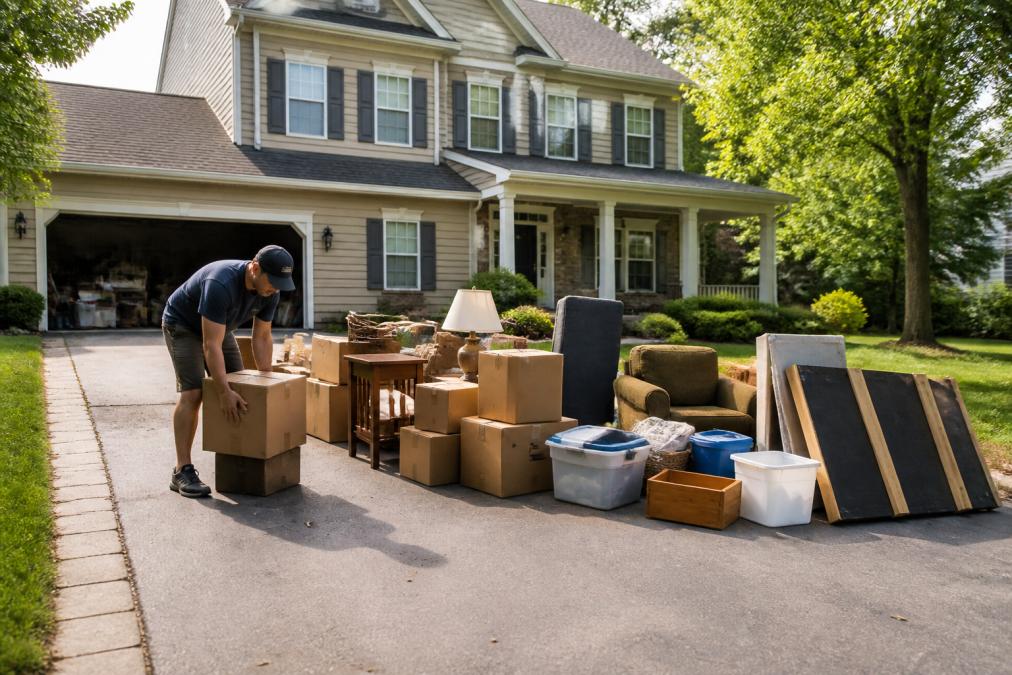
Preparation makes the pickup faster and protects your home. Clear a path to the items, remove anything you want to keep from the pile, and secure pets.
The Prep Checklist
- Separate keep items from haul items
- Clear a walkway to each pile
- Empty and defrost refrigerators and freezers
- Remove drawers or loose parts that could fall
- Confine pets to a closed room
- Note anything fragile or heavy for the crew
Heavy-Item Dismantling: What to Take Apart and What to Leave Whole
Most haulers will take furniture whole. A few rules of thumb:
- Bed frames and headboards: Disassemble. They're awkward, not heavy, and flat-packed pieces stack tight.
- Sectionals: Leave whole unless the doorway won't clear it. Sofa frames are hard to reassemble and crews prefer to carry them out intact.
- Desks and dressers: Empty every drawer. A loaded dresser is a two-person lift that can crack the frame; an empty one is a one-person carry.
- Treadmills and exercise equipment: Leave assembled. The motor housing and belt are the heavy parts, and disassembly rarely saves space.
- Pianos and safes: Never attempt to move these yourself. Point them out and let the crew handle the lift.
Bundling Yard Waste and Branches
If your municipality collects yard debris, the bundling rules are usually strict and enforced at the curb:
- Branch diameter: Most programs cap branches at 3 to 4 inches in diameter.
- Length: Cut to 4 feet or less in most jurisdictions.
- Bundle size: Tie in bundles no heavier than 50 pounds, secured with twine or rope, not wire or plastic strapping.
- Bagged material: Use paper yard-waste bags where required; plastic bags are often rejected.
- Loose leaves: Many programs require them bagged or in a labeled bin, not swept into a pile.
Staging to Prevent Injury and Property Damage
A few staging habits that protect both you and your home:
- Stage at ground level when possible. If the crew can reach it from the driveway, you've eliminated the stair carry entirely.
- Lay cardboard or a moving blanket along the path from the item to the door if you have finished floors.
- Remove doors from hinges on tight hallways rather than forcing a sofa through.
- Keep the pile clear of the walkway so the crew isn't stepping over debris while carrying something heavy.
- Point out fragile or heavy items to the crew lead before they start, not mid-carry.
DIY vs. Professional Hauling: A Cost and Safety Comparison
DIY hauling looks cheaper on paper. You rent a truck or trailer, load it yourself, pay landfill or transfer station fees, and spend a full day on the job.
| Factor | DIY Hauling | Professional Hauling |
|---|---|---|
| Upfront cost | Lower | Higher |
| Time required | Most of a day | A few hours |
| Injury risk | High for heavy items | Handled by trained crew |
| Disposal | You sort and drive it | Included |
| Floor protection | Your problem | Crew-managed |
| Best for | Light, small loads | Heavy, bulky, or urgent jobs |
Sustainable Disposal: Where Your Debris Actually Goes
Responsible hauling isn't just about getting stuff out of your house. It's about where it lands. Landfill diversion matters, and good operators sort before they dump.
Frequently Asked Questions
How much does residential debris removal cost?
Pricing for residential debris removal depends on volume, item weight, and how accessible the debris is. Most providers charge by truckload rather than by the hour. A single appliance costs less than a full garage cleanout, and heavy materials like concrete or tile carry higher rates because of landfill fees. Ask for a written, itemized quote before booking so you know exactly what is included and what is not.
What is the difference between bulk trash pickup and private junk removal?
Bulk trash pickup is a scheduled municipal service limited to a few items placed at the curb on set dates. Private junk removal crews enter your home or garage, lift heavy items, load everything themselves, and haul it away the same day. Private service costs more but handles volume, tight spaces, and same-day scheduling that municipal curbside collection cannot match.
What items are typically prohibited in residential debris removal?
Most haulers cannot take hazardous waste, including paint, motor oil, pesticides, propane tanks, asbestos, and medical waste. Tires, batteries, and fluorescent bulbs also require special handling. These items need to go to a household hazardous waste facility or a certified recycler. Ask your provider for a full prohibited-items list before your pickup date so nothing gets left behind.
Is same-day residential debris removal available?
Many local haulers offer same-day or next-day service, especially for single-item pickups and small cleanouts. Availability depends on crew schedules and your location. If you are preparing a home for listing or clearing a rental between tenants, call early in the day and confirm the pickup window in writing. Larger jobs, like full estate cleanouts, usually need to be booked a day or two ahead.
Clearing out a home, garage, or estate shouldn't mean weeks of hauling trips and a sore back. Load & Leave handles residential debris removal with custom quotes, same-day availability, floor protection, and total discretion from start to finish. Whether it's a single piano or a full-property cleanout, the crew carries it out and leaves the space immaculate. Get a free quote from Load & Leave and clear the space without the hassle.
Frequently asked questions
Pricing for residential debris removal depends on volume, item weight, and how accessible the debris is. Most providers charge by truckload rather than by the hour. A single appliance costs less than a full garage cleanout, and heavy materials like concrete or tile carry higher rates because of landfill fees. Ask for a written, itemized quote before booking so you know exactly what is included and what is not.
Bulk trash pickup is a scheduled municipal service limited to a few items placed at the curb on set dates. Private junk removal crews enter your home or garage, lift heavy items, load everything themselves, and haul it away the same day. Private service costs more but handles volume, tight spaces, and same-day scheduling that municipal curbside collection cannot match.
Most haulers cannot take hazardous waste, including paint, motor oil, pesticides, propane tanks, asbestos, and medical waste. Tires, batteries, and fluorescent bulbs also require special handling. These items need to go to a household hazardous waste facility or a certified recycler. Ask your provider for a full prohibited-items list before your pickup date so nothing gets left behind.
Many local haulers offer same-day or next-day service, especially for single-item pickups and small cleanouts. Availability depends on crew schedules and your location. If you are preparing a home for listing or clearing a rental between tenants, call early in the day and confirm the pickup window in writing. Larger jobs, like full estate cleanouts, usually need to be booked a day or two ahead.